Painted by Susanne Foitzik
My PhD Research
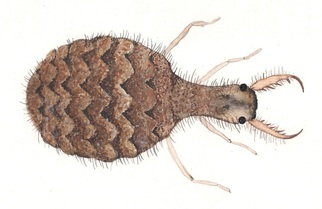
My PhD research in the lab of Prof. Ofer Ovadia dealt with a sit-and-wait predator, the pit-building antlion. My work was composed of three complementary parts: (1) the foraging behavior of this interesting predator which ambushes its prey while buried in sand; (2) the evolution of life-history traits of pit-building antlions; (3) simulation models of searching strategies, especially comparing between the sit-and-wait and the widely foraging mode (i.e., active search of prey), which is more common in nature.
Foraging behavior has been developed for widely foraging animals (i.e., animals that actively search for their prey) and it was enriching to draw analogies between the classical theory and its possible applications to sit-and-wait predators, which also construct traps (e.g., spiders and antlions). Their behavior was often considered as automatic or stereotypic, but I showed that antlions greatly respond to their environment by modifying their trap and its construction. For example, antlions evolved to respond to intrinsic and extrinsic factors, such as hunger level and predation risk, while constructing and maintaining their pits. In addition, my research has shown that antlions exhibit high levels of phenotypic plasticity, and are sensitive to growth conditions, such as temperature, humidity and food availability. More specifically, life-history traits have both genetic and plastic components, and a significant interaction term. Antlions from the Mediterranean region of Israel are larger and develop more slowly compared to antlions from the desert region. The former showed higher plasticity levels than the latter. In relation to simulation models of searching strategies, I programmed several simulation models. One simulation model compared the efficiency of predators that actively search for their prey with predators that use the sit-and-wait strategy. I showed that the sit-and-wait foraging mode is not as inferior as previously thought, and it can do quite well, especially when the prey and predator use directional movement. Therefore, it suggests specific conditions under which the sit-and-wait foraging mode can more easily evolve.
Two selected publications:
Behavior of pit-building antlions: Scharf I, Lubin Y, Ovadia O (2011) Foraging decisions and behavioural flexibility in trap-building predators: a review. Biological Reviews 86:626-639.
Life-history of pit-building antlions: Scharf I, Filin I, Golan M, Buchshtav M, Subach A, Ovadia O (2008) A comparison between desert and Mediterranean antlion populations: Differences in life history and morphology. Journal of Evolutionary Biology 21:162-172.
My PhD research in the lab of Prof. Ofer Ovadia dealt with a sit-and-wait predator, the pit-building antlion. My work was composed of three complementary parts: (1) the foraging behavior of this interesting predator which ambushes its prey while buried in sand; (2) the evolution of life-history traits of pit-building antlions; (3) simulation models of searching strategies, especially comparing between the sit-and-wait and the widely foraging mode (i.e., active search of prey), which is more common in nature.
Foraging behavior has been developed for widely foraging animals (i.e., animals that actively search for their prey) and it was enriching to draw analogies between the classical theory and its possible applications to sit-and-wait predators, which also construct traps (e.g., spiders and antlions). Their behavior was often considered as automatic or stereotypic, but I showed that antlions greatly respond to their environment by modifying their trap and its construction. For example, antlions evolved to respond to intrinsic and extrinsic factors, such as hunger level and predation risk, while constructing and maintaining their pits. In addition, my research has shown that antlions exhibit high levels of phenotypic plasticity, and are sensitive to growth conditions, such as temperature, humidity and food availability. More specifically, life-history traits have both genetic and plastic components, and a significant interaction term. Antlions from the Mediterranean region of Israel are larger and develop more slowly compared to antlions from the desert region. The former showed higher plasticity levels than the latter. In relation to simulation models of searching strategies, I programmed several simulation models. One simulation model compared the efficiency of predators that actively search for their prey with predators that use the sit-and-wait strategy. I showed that the sit-and-wait foraging mode is not as inferior as previously thought, and it can do quite well, especially when the prey and predator use directional movement. Therefore, it suggests specific conditions under which the sit-and-wait foraging mode can more easily evolve.
Two selected publications:
Behavior of pit-building antlions: Scharf I, Lubin Y, Ovadia O (2011) Foraging decisions and behavioural flexibility in trap-building predators: a review. Biological Reviews 86:626-639.
Life-history of pit-building antlions: Scharf I, Filin I, Golan M, Buchshtav M, Subach A, Ovadia O (2008) A comparison between desert and Mediterranean antlion populations: Differences in life history and morphology. Journal of Evolutionary Biology 21:162-172.
Painted by Susanne Foitzik
My post-doc research
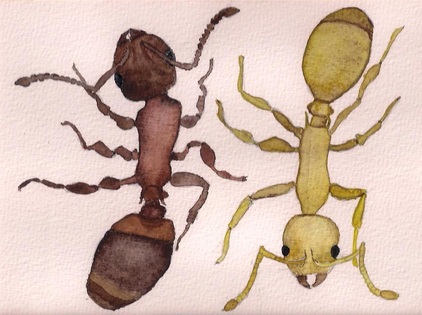
My post-doc training in the lab of Prof. Susanne Foitzik, mainly dealt with the behavioral and life-history responses of potential host colonies to the presence or attack by slavemaking ants. Slavemaking ants are social parasites which invade host colonies and steal worker pupae. The later-emerged enslaved workers perform all the routine tasks in the slavemaking ants’ colony, while the slavemaking workers specialize in robbing host colonies for more brood. Because such a slavemaker invastion involves serious costs, the host colonies are selected to aggressively defend their colonies against such attacks. Host colonies were indeed found to differentiate between different intruders and to respond most aggressively to slavemakers. They also "remember" such an attack for several days, increasing their general aggressiveness.
I also worked on the interaction of individual ants and the colony as a whole with another type of parasite – a tapeworm gut-parasite – having strange effect on behavior and morphology. Infected workers are smaller, have another color and are very lazy. When they do something, it is only cleaning themselves or passive/self-directed activities (such as being fed or begging for fed). The inactivity of infected workers should have been translated to reduction in colony new production of workers, queens and males. Surprisingly, the effect of parasitism on the colony production is not that severe, and is only a somewhat biased male-ratio of the new production of males and queens. It points to social buffering of workers' inactivity, but an open question is to which extent and proportion insect societies can tolerate worker reduced activity.
Two selected publications:
Host ants' interaction with social parasites: Scharf I, Pamminger T, Foitzik S (2011) Differential response of ant colonies to intruders: Attack strategies correlate with potential threat. Ethology 117:731-739.
Host ants' interaction with gut parasites: Scharf I, Modlmeier AP, Beros S, Foitzik S (2012) Ant societies buffer individual-level effects of parasite infections. American Naturalist 180:671-683.
My post-doc training in the lab of Prof. Susanne Foitzik, mainly dealt with the behavioral and life-history responses of potential host colonies to the presence or attack by slavemaking ants. Slavemaking ants are social parasites which invade host colonies and steal worker pupae. The later-emerged enslaved workers perform all the routine tasks in the slavemaking ants’ colony, while the slavemaking workers specialize in robbing host colonies for more brood. Because such a slavemaker invastion involves serious costs, the host colonies are selected to aggressively defend their colonies against such attacks. Host colonies were indeed found to differentiate between different intruders and to respond most aggressively to slavemakers. They also "remember" such an attack for several days, increasing their general aggressiveness.
I also worked on the interaction of individual ants and the colony as a whole with another type of parasite – a tapeworm gut-parasite – having strange effect on behavior and morphology. Infected workers are smaller, have another color and are very lazy. When they do something, it is only cleaning themselves or passive/self-directed activities (such as being fed or begging for fed). The inactivity of infected workers should have been translated to reduction in colony new production of workers, queens and males. Surprisingly, the effect of parasitism on the colony production is not that severe, and is only a somewhat biased male-ratio of the new production of males and queens. It points to social buffering of workers' inactivity, but an open question is to which extent and proportion insect societies can tolerate worker reduced activity.
Two selected publications:
Host ants' interaction with social parasites: Scharf I, Pamminger T, Foitzik S (2011) Differential response of ant colonies to intruders: Attack strategies correlate with potential threat. Ethology 117:731-739.
Host ants' interaction with gut parasites: Scharf I, Modlmeier AP, Beros S, Foitzik S (2012) Ant societies buffer individual-level effects of parasite infections. American Naturalist 180:671-683.
